When Your Parent Says "I'm Fine" and You Know They're Not
You have seen the signs. The mail by the door, the weight she's lost, the way she changes the subject when you ask how she's really doing. You have done the hard part already — you noticed. And so you did the natural thing. You sat down with her, gently, and you offered to help. Maybe you suggested someone could come by. Maybe you floated the idea of a little support around the house.
And she said, "I'm fine. I don't need anyone. Stop worrying about me."
If you are reading this, there is a good chance you are not stuck because you can't see the problem. You are stuck because the person you love most is standing between you and the solution, with her arms crossed, telling you everything is fine.
I want you to know something before we go any further: you are not failing, and she is not being unreasonable. What you are running into is one of the most common, most human moments in all of caregiving. And there is a way through it that does not require winning an argument.
Why "I'm fine" is almost never about being fine
When a parent refuses help, it is easy to hear it as stubbornness. It usually isn't. Underneath "I'm fine" is almost always something tender.
For most of your parent's life, being capable was who they were. They were the one who took care of you. They drove the carpool, paid the bills, held the family together, fixed what was broken. Independence is not a preference for them. It is identity. And when a son or daughter offers help, however lovingly, what a proud parent often hears is, "You can't take care of yourself anymore." That is a frightening thing to hear. So they push it away — not because they don't need help, but because admitting they do feels like losing themselves.
There is fear in it too. Fear of being a burden to you, because they have watched you build your own busy life and they do not want to take from it. Fear of losing control over their home, their routine, their choices. Fear of what accepting help is the first step toward — the move, the decline, the thing nobody wants to name out loud.
Once you understand that "I'm fine" is a door held shut by love and fear rather than by simple denial, everything about how you approach it changes.
Why pushing harder usually backfires
Here is the honest part that most articles skip. When we are worried about someone, our instinct is to push — to explain more clearly, to bring more evidence, to make the case until they finally see it our way. With a resistant parent, this almost always makes things worse.
The more you press, the more the conversation becomes about the very thing they are most afraid of: that they are no longer capable. Every appointment you try to schedule, every helper you try to introduce, lands as proof of decline. So they dig in. The conversation turns into a standoff, and standoffs with the people we love are exhausting and lonely. You drive home feeling like you failed, and nothing has changed except that the subject is now a little more painful to raise next time.
You cannot force trust, and you cannot argue someone into accepting care. I know that is not the answer you were hoping for. But there is a quieter path that actually works, and it asks much less of you than the fight does.
What actually opens the door
The families who get through this almost never do it by convincing the parent. They do it by lowering the stakes — by making help feel like company instead of a verdict.
Think about the difference between these two things. A "caregiver" arriving at the door announces, in your parent's mind, that they have a problem. But a friendly person who simply stops by — someone who sits with them, asks about the photos on the wall, helps sort through that confusing insurance letter while they chat — that is not a verdict. That is just a good part of the week. No proud parent refuses a visit from someone they have come to enjoy.
This is the part that surprises families: trust is not built in the big conversation. It is built in the small, low-pressure moments that come before anyone uses the word "help." Someone consistent and warm shows up, again and again, and slowly becomes a familiar, welcome presence. By the time anything practical needs handling, it isn't an intervention. It is simply a friend lending a hand. The acceptance happens quietly, almost without anyone deciding it.
And here is what that does for you. The pressure stops being all on your shoulders. You no longer have to be the one delivering hard truths and absorbing the resistance, over and over, while still trying to be her son or daughter. You get to step back into that softer role, and let the trust build through someone whose whole purpose is to be that gentle, steady presence.
The goal was never to win the argument
I think the most freeing thing I can tell you is this: you were never supposed to win the argument with Mom. That was never the path.
The goal is much kinder than that. It is simply to get a trusted person into her week — someone who notices what you can't from a distance, who handles the small things before they become big ones, and who keeps you in the loop so you are never again guessing from a 10-minute phone call. Not because you forced it. Because the trust was there first.
This is exactly the work I do for families in San Mateo County and around the Bay Area. I come in not as a clinical presence, but as a friendly, consistent local point person — the kind of company a proud parent welcomes rather than resists. Over time, I become the eyes and ears nearby so you can breathe a little easier from wherever you are.
If your parent keeps telling you they're fine and you can't shake the feeling that they're not, you don't have to keep carrying that alone, and you don't have to keep losing the argument. Let's just talk about what you're seeing. No pressure, no obligation — only a calmer path forward.
You can reach me directly at 415.632.7225 or makeitcount@silverstronglife.com.
Franklin Tieu is the founder of Silver Strong Senior Concierge, a Family Management service based in San Mateo County. After spending nearly two decades managing care for his own aging parents, Franklin now helps local families stay informed and supported when they can't be with their parents every day.
The Small Things Are Not Small
Most families do not notice the moment their parent begins to change. The change does not announce itself. It arrives as a forgotten appointment, an unopened envelope on the dining room table, a friend who stopped calling because Mom was not returning messages. Each of these can look minor that family can’t easily dismiss it as one off. Maybe she is just tired or she can be forgetful about the mail some times. The explanations are not wrong, exactly. They are simply incomplete.
The small things rarely travel alone
What the research on aging has shown, consistently and across decades, is that small signs of decline in older adults rarely arrive in isolation. When one appears, the probability that others have already begun is high. A large national study of older adults found that the presence of any single change — in memory, in mood, in mobility, in daily function — significantly increased the odds of other changes co-occurring, often by a factor of seven or eight. The clinical term for this is the clustering of geriatric syndromes. The plain-language version is this: the small things are not small, because they almost never travel alone.
What adult children typically see, from a distance and during brief visits, is fragments. A pile of mail that was not there last time. A fridge with milk three weeks past its date. A scrape on the back bumper of the car that no one can quite explain. A medication slot that was supposed to be filled on Tuesday and was not. A phone call Mom mentioned receiving from someone claiming to be from Medicare, asking about her bank account. A church group she stopped attending eight months ago after her closest friend moved away. Each fragment, taken alone, is the kind of thing any family would set aside and not think about again. Taken together, they describe a pattern that the family has not yet named because no one has sat with all of them in one place at the same time.
What comes next when no one is watching
The reason this matters is not the small things themselves. It is what tends to come next when no one is watching. Research funded by the National Institute on Aging has documented that financial decision-making decline begins, on average, five years before any clinical diagnosis is made. Missed bill payments and falling credit scores appear in the data long before the family has any idea what is happening. Social withdrawal, once it sets in, accelerates cognitive change rather than simply reflecting it. Medication lapses compound into hospitalizations. A house that is not being maintained becomes a fall risk. The trajectory that begins with three small things tends, over twelve to twenty-four months, to produce one large thing — the hospitalization, the discovered loss, the fall, the rushed decision about where Mom should live next. By that point the family is not making a careful choice. The family is reacting, under pressure, with the worst possible information and the least possible time.
The gap that produces the worst outcomes
What is true, and rarely said, is that nearly all of the costliest outcomes in aging are not caused by the underlying decline itself. They are caused by the gap between when something begins and when someone notices. The decline is going to happen regardless. What changes the outcome is how long the gap is. A family that catches the pattern early has months or years to plan, to bring in the right professionals, to involve the parent in her own decisions while she is still able to participate in them, to put protections in place before they are needed in an emergency. A family that catches the pattern late has none of that. The two endings look entirely different from the inside, and the difference is not luck. It is attention.
This is the recognition that most families arrive at too late, not because they did not care, but because they were busy, far away, and reading each small thing in isolation rather than as part of a pattern. The work of seeing the pattern is the work that almost no one in the eldercare system is currently doing. Home care agencies activate when a parent needs help with bathing. Placement advisors activate when the family has decided to move. Doctors see a parent for fifteen minutes twice a year. The space between full independence and the first crisis — the space where the pattern is forming and the small things are accumulating — is the space where families are alone. It does not have to be.
What to do when you start seeing the small things
If you are reading this and recognizing your own parent, the most useful thing you can do is sit down with a piece of paper and write down every small thing you have noticed in the last twelve months, however minor. Not what you concluded about each one at the time. Just what you saw. When you read the list back, you may find that the pattern was already there, and that you had been holding it in fragments without ever putting it together. That recognition is not a crisis. It is the beginning of having time.
If you are seeing the small things with your own parent and want to talk through what they might mean together, reach out. That is what I do, and the conversation is the place to start.
Contact Franklin at (415) 632-7225 or makeitcount@silverstronglife.com
What Adult Children Should Know About Financial Elder Abuse
A Bay Area senior care advocate on why financial elder abuse goes undetected, what families miss, and how to protect aging parents before damage is done.
Most families do not talk about elder scams until after it has already happened. By then, the money is gone, the trust is broken, and the conversation that should have happened months or years earlier feels impossibly late. I have lived this. Back in 2019, my mother was scammed for 3 million dollars. I spent the years that followed filing lawsuits against the fraudsters and working with law enforcement until the key player was arrested by the Department of Justice. My mother eventually found the courage to share what happened publicly in an interview with ABC's Dion Lim, hoping it would spare other families the same experience. It does not always spare them. Financial elder abuse is one of the fastest-growing forms of fraud in the United States, and adult children consistently underestimate how exposed their parents actually are. This post is for the families who are not sure where to start.
Why aging parents are systematically targeted
Financial fraud against seniors is not opportunistic, it is operational. There are organized groups who study how cognitive decline, loneliness, and trust work in older adults, and they build campaigns specifically designed to exploit those vulnerabilities. Phone scams, fake IRS calls, the grandchild-in-trouble call at 2am, romance scams, fake tech support, and increasingly sophisticated impersonations of banks and government agencies all fall under this umbrella. The hardest version to detect, and often the most devastating, is when the perpetrator is a family member, a caregiver, or a long-trusted friend. These cases rarely make the news, and they account for a significant share of the financial losses seniors experience each year.
Why the standard family conversation does not work
Most adult children, when they think about elder scams, plan to have a conversation with their parents. They sit down, they share an article, they say "Mom, please be careful, do not give your information to anyone over the phone." This conversation almost never produces lasting protection. There are three reasons.
First, parents generally assume they have it under control. The same self-image that has carried them through fifty or sixty years of adult life does not yield to a single warning from their child.
Second, by the time scammers are actively engaged with a senior, they have often built a relationship that feels more attentive and more affirming than the relationships the senior has with their own family. The scammer calls every day, remembers details, makes senior feel important, “kills them with kindness”, and tells them they are independent and don’t need to burden their children. A child saying "do not trust this person" is asking the parent to give up something that, on a daily emotional level, feels good.
Third, cognitive decline does not announce itself. A parent who could spot a scam at 65 may not spot the same scam at 75.
What may actually help
The protective strategies that work are not single conversations. They are sustained patterns over time. Three matter most.
The first is a family plan for how major financial decisions are handled and by whom. This typically involves working with an estate planning attorney to put a durable power of attorney in place, naming a trusted financial agent, and having clear documentation about who can act on the parent's behalf if needed. This is not a one-meeting task. Families that do this well revisit the plan every few years.
The second is consistent presence. Scams take root when a senior is isolated and the family is distant or busy. A parent who sees a son or daughter regularly, or who has a trusted person involved in their week, is meaningfully harder to exploit. The scam relies on being the most consistent voice in the senior's life. Crowding that out with other consistent voices reduces the opening.
The third is paying attention to behavioral changes. The unusual phone calls such as a new caller a parent keeps talking about but will not name. Mail piling up with letters from companies the parent has never mentioned. New urgency about money that does not match their normal patterns (what does a parent suddenly need to make a larger withdrawal than usual). These are signals, and they show up well before the loss becomes catastrophic, but only if someone is close enough to notice.
For families who cannot be there in person
Many adult children are managing this from another city or another state. Work, family obligations, and physical distance make daily presence impossible. FaceTime calls help, but parents almost always say everything is fine, because they do not want their children to worry.
This is the gap Silver Strong was built to fill. As a non-medical senior care advocate based in San Mateo County, I work with families to provide the kind of consistent, on-the-ground presence that protects against slow-developing problems, including financial exploitation. That includes coordinating appointments and paperwork, helping with home logistics, and being a regular, trusted person in the senior's week who can flag what families miss from a distance.
If you are an adult child quietly worried about your parents, especially here in the Bay Area, I am happy to talk. You can schedule a Family Clarity Visit through the Get Started page, or reach me directly at 415.632.7225.
Caring for Aging Parents: Why a well thought out plan is important for the whole family
I spoke with a woman named Nicole recently. She reached out to me because she'd seen some of my posts about helping aging parents. She didn't need my help as she'd already been through it. She just wanted to talk to someone who understood what it's like when the world turns upside down and when there's only one person holding it together.
The Family Had a Plan
Nicole's parents had done more than most. They went to an attorney and set up a trust. Her dad managed the finances, the insurance, the bills so her mom didn't worry about any of it. They were loving, involved parents and not careless. They had a plan. At least they thought they did.
The Accident
Nicole's dad was hit by a car while riding his bike. The injuries were severe, including a traumatic brain injury. The kind that doesn't heal and go away. He was going to need ongoing care, potentially for years. Her mom shut down. She had never touched the finances, never dealt with insurance, never looked at the legal documents. She didn't know where anything was and couldn't make sound decisions. So Nicole stepped in.
She didn't know where to start so she began Googling. "What to do when a parent is hospitalized." "How to get power of attorney." "Who pays for long-term care." One search led to another, and one phone call led to three more. She was learning the entire system from scratch while her dad was in the hospital and her mom was feeling stressed at home.
The trust her parents set up did not work quite as expected. Nicole only discovered this after she started digging through the paperwork looking for answers. Her dad was listed as the decision-maker on every account and directive and there was no backup. There was no Advance Health Care Directive. No HIPAA authorization. As a result, Nicole had no legal standing to step in for either of them. She had to figure out how to get that authority while simultaneously learning what medications her dad was on, what insurance they had, what bills were due, and what her dad's care was going to cost.
Every problem was its own silo. For example, the attorney for legal questions, the insurance company for coverage, the hospital for medical decisions or the bank for account access. Nicole was the only one handling it and had to connect the dots.
She told me something I haven't been able to shake: "The two people we always looked to for guidance needed the guiding. And nobody was there to do it."
Why the Plan Wasn't Enough
Nicole's parents did what they thought was right. They went to an attorney and set up a trust. But then they stopped as they thought that was enough. A trust mainly covers assets and finances but it doesn't cover medical decisions or give Nicole permission to talk to their doctors, provide medication information, insurance information or general billing information. That's why it's important to set up a plan that is holistic and covers all of life's most important areas.
They had one piece of the plan and assumed it was the whole thing. Nobody helped them see what was missing and by the time Nicole found out, she was already in the middle of a crisis with no roadmap.
Where to Start
If Nicole's story sounds familiar, or if it made you think about your own parents, here are 5 basic things you could prepare and then gradually add on more.
Know your parents' medications. Ask your parents what they're taking, what it's for, and what the dosage is. Take a photo of every pill bottle label and save it on your phone. If your parent ends up in an ER, the first thing they'll ask you is what medications they're on.
Know their doctors. Primary care doctor, any specialists, and what they're being seen for. Get names and phone numbers. Write them down somewhere you can find at 2 AM.
Get a HIPAA authorization signed. Without this, their doctors can't legally share your parent's medical information with you. You can download the form online, print it, and get it signed at the kitchen table over coffee. It takes five minutes and it means you won't be shut out of a conversation when it matters most.
Know their insurance. Find out if your parents have Medicare, a supplemental plan, or both. Ask where the cards are. Take a photo of the front and back of every insurance card and save it on your phone.
Get an Advance Health Care Directive in place. This is the document that names someone to make medical decisions for your parent if they can't make them for themselves. Without it, no one in your family has the legal authority to say yes or no to a treatment, a surgery, or a care plan. Your parent can download the form, fill it out, and get it signed without an attorney.
How Silver Strong can help
What Nicole needed wasn't someone to take over. It was someone to walk alongside her. Someone who could look at the whole situation and say "here's what matters most right now, here's what can wait, and here's who to call for that." Someone who could help her connect the dots instead of fighting through every silo alone.
That's what Silver Strong does. When your family needs clarity or relief, we are here so you don't have to do this alone.
Learn more at silverstronglife.com or write to makeitcount@silverstronglife.com
Written by Franklin Tieu, founder of Silver Strong Life. Read my story at silverstronglife.com/mystory
You Visited Mom Last Weekend and Something Felt Off
You drove over on Sunday — maybe it's 30 minutes away, maybe 45. You weren't planning to stay long. Just a quick check-in between soccer practice and grocery shopping. But when you walked in, something felt different. The mail was piling up by the front door. The fridge was nearly empty. Mom looked like she'd lost weight since your last visit. And there was a dent on the car you'd never seen before. You asked how she was doing. She said, "I'm fine." You drove home and can’t help but wonder and worry.
You're Not Imagining It
If you've had that gut feeling after visiting your parent, you're not alone. Millions of adult children experience the same quiet realization: Mom or Dad might not be managing as well as they once did.
The challenge is that decline doesn't usually announce itself. There's rarely a single dramatic moment. Instead, it's a slow accumulation of small things — things that are easy to miss when you're only visiting a couple of times a month and your parent keeps telling you everything is fine.
Here are some of the most common signs families notice:
Around the house
Unopened mail or past-due bills stacking up
A fridge that's empty or full of expired food
The house is messier or dirtier than usual
Repairs going unaddressed — a leaky faucet, burned-out lightbulbs, overgrown yard
Changes in appearance and behavior
Noticeable weight loss
Wearing the same clothes repeatedly
Decline in personal grooming or hygiene
Withdrawing from activities they used to enjoy
Seeming more confused, forgetful, or easily agitated during your visits
Safety concerns
New dents or scratches on the car
Difficulty getting up from a chair or navigating stairs
Unexplained cuts and bruises
Medications that are ahead of or behind schedule
Burnt pans and pots
Poorly lite Rooms
Communication shifts
Repeating the same stories or questions within a single conversation
Difficulty following along or finding the right words
Less enthusiasm on the phone — shorter calls, less engagement
What Most Families Do (and Why It Doesn't Always Work)
When adult children first notice these signs, the instinct is usually one of three things:
1. Call more often. You start checking in by phone every day or every other day. But phone calls only tell you what Mom wants you to hear. You can't see the mail piling up or the empty fridge over the phone.
2. Visit more often. You try to get over there every weekend. But it's hard to sustain — you have your own life, your own family, your own responsibilities. And every visit becomes a quiet audit that stresses both of you out.
3. Ask a sibling to help. If you have siblings nearby, you try to divide the responsibility. But coordinating between multiple people — each with their own schedule, their own perspective, and their own relationship with Mom — often creates more confusion than clarity. Information falls through the cracks. Nobody has the full picture.
None of these are bad approaches. But none of them solve the core problem: nobody is consistently watching the full picture, noticing the small changes over time, and keeping the family informed in a clear, organized way.
What Actually Helps
What most families in this situation need isn't a medical professional. Mom may not need a nurse or a home health aide — at least not yet.
What she needs is someone local who:
Checks in regularly — not just a phone call, but someone who actually visits, sees the house, sees how she's doing, and notices what's changed since last time
Catches the small stuff — the expired medications, the missed appointment, the growing pile of mail, the subtle shift in how she's moving around the house
Communicates clearly back to the family — so you're not guessing, not relying on "I'm fine," and not trying to piece things together from a 10-minute phone call
Handles things as they come up — whether it's scheduling a doctor's appointment, calling a repair person, sorting out a confusing insurance letter, or simply making sure the fridge has food in it
Builds a complete picture over time — so the family has one clear, organized view of what's going on with Mom instead of scattered information across siblings, voicemails, and half-remembered conversations.
If you've noticed the signs — if you've had that drive home where you couldn't stop thinking about it — trust your instinct. That gut feeling is telling you something.
If you're in this situation and you're not sure what to do next, a good first step is simply getting a clear picture of what's really going on with your parent.
Not what Mom tells you on the phone. Not what you can piece together from a quick weekend visit. But an honest, thorough look at how she's doing day to day — her home, her health, her routine, her safety — from someone who knows what to look for.
That's what I do for families in San Mateo County and the surrounding Bay Area. I visit your parent, assess the full situation, and give you a clear, honest picture of where things stand — along with practical recommendations for what to do next.
If that gut feeling after your last visit won't go away, I'm happy to talk. No pressure, no obligation — just a conversation about what you're seeing and how to move forward. Write to me at makeitcount@silverstronglife.com
When One Sibling Does Everything: Help for San Mateo County Families Caring for Aging Parents
You're the one who drives Mom to her appointments at Seton or Mills-Peninsula. You're the one sorting through Dad's insurance paperwork. You're the one who gets the call at 10pm when something goes wrong. And your siblings? They care. At least they say they do. But somehow, you're the one doing all of it. If this sounds like your life, you're not alone. In most families with aging parents, one sibling — usually the one who lives closest or who stepped in first and ends up carrying nearly the entire load. The rest of the family stays on the sidelines. Not necessarily out of malice. Sometimes they live out of state, or across the Bay, or even just far enough away that the daily grind of caregiving never lands on them. Sometimes they don't realize how much is involved. Sometimes they just... don't step up.
It doesn't matter why. What matters is that you're probably exhausted, you're resentful, and something has to change.
Here's what actually works.
Stop Hinting and Start Asking for Specific Help
One of the most common mistakes the primary caregiver makes is expecting siblings to notice the workload and volunteer. They won't. They can't see what they're not there to witness. Instead of saying "I could really use some help," try: "Dad has a cardiology appointment next Thursday at 2pm in San Mateo. Can you take him?" That's a concrete ask with a date, a time, and a clear task. It's much harder to brush off than a vague request. If they say no, ask what they can do. Not everyone has the same availability or skills — and that's okay. Maybe your brother can't drive Dad to appointments but he can handle the insurance calls from wherever he lives. Maybe your sister can't visit weekly but she can research home care options on the Peninsula or contribute financially toward outside help.
The goal isn't equal effort. It's getting everyone doing something.
Make the Invisible Work Visible
The sibling who isn't doing the caregiving often has no idea how much time and energy it takes. They picture you stopping by Mom's house in Belmont once a week. They don't see the four phone calls to the pharmacy, the three hours at the doctor's office, the midnight worry when Mom didn't answer the phone. One practical step: keep a simple log for two weeks. Write down every caregiving task you do and roughly how long it takes. Then share it with your siblings. This is not as an accusation, but just as information. When a sibling can see that you spent 14 hours last week managing Dad's care, the conversation shifts from "I don't think we need to do anything differently" to "Okay, how do we divide this up?"
Call a Family Meeting
This isn't a venting session. It's a planning meeting. The goal is to walk out with a plan that assigns real tasks to real people. Set the agenda ahead of time so nobody feels ambushed. Cover three things: what care does Mom or Dad currently need, who is doing what right now, and how to divide things more fairly going forward.
If the conversation always spirals into old arguments, consider bringing in a neutral third party — a social worker, a family mediator, or a local care coordinator who can keep the discussion focused on what your parent actually needs. Here in San Mateo County, the Aging and Adult Services division and organizations like the Family Caregiver Alliance offer resources that can help facilitate these conversations.
Sometimes an outside professional can say things that siblings can't hear from each other. When someone objective visits the house and says "your father isn't managing safely on his own," it carries more weight than when the caregiver sibling has been saying it for months.
Match Tasks to Each Sibling's Strengths and Situation
Not every sibling can contribute in the same way. A sibling who lives in Los Angeles can't drive Mom to the doctor in Burlingame, but they can handle research, make phone calls, manage finances, coordinate with insurance, or set up online prescription refills. Think of it like a team. One sibling might handle the hands-on visits. Another manages the paperwork. A third contributes financially so you can bring in outside help. The key is that everyone has a defined role and everyone knows what's expected of them.
The worst outcome is when one sibling is doing everything and the others assume someone else is handling it. Clarity prevents that.
Give Yourself Permission to Set Boundaries
If you've asked, shared the workload, called the family meeting, and your siblings still won't step up — at some point, you may need to accept that this is who they are. That's painful, but it's also freeing. Setting boundaries might mean saying: "I can handle two doctor appointments a month but not four. For the other two, we either need someone else to step in or we need to hire help." This isn't abandoning your parent. It's making sure you don't burn out, because your parent needs you functional for the long haul.
Caregiver burnout is real and it doesn't help anyone — not you, not your parent, and not your family.
Bring in Local Support
When the family can't — or won't — fill the gap, there are real options right here on the Peninsula. Home care agencies, adult day programs, geriatric care managers, and local senior care coordination services can take on many of the tasks that are wearing you down.
San Mateo County has a strong network of senior services, including the Aging and Adult Services division, local senior centers in communities like Belmont, San Carlos, Foster City, and Redwood City, and private professionals who specialize in exactly this kind of family support.
Bringing in outside help isn't giving up. It's building a team around your parent that doesn't depend on one person doing everything.
Sometimes the best thing a long-distance sibling can do is fund professional help so the nearby sibling gets relief. And sometimes the best thing the primary caregiver can do is stop trying to do it all alone and let a professional handle the coordination, the check-ins, and the details — so they can go back to just being a son or daughter.
You Don't Have to Carry This Alone
The sibling dynamic around aging parents is one of the most stressful things a family can go through. Old roles, old resentments, and old patterns all come flooding back at the worst possible time. But the most important thing is this: your parent's care shouldn't depend on one person's willpower. Whether it's through better communication with your siblings, professional mediation, or bringing in outside help, there are ways to share the load.
If you're in San Mateo County and you're the sibling carrying everything — or if you're the sibling who wants to help but doesn't know how — I work with families on exactly this. A short conversation might be all it takes to figure out a better path forward.
Franklin Tieu is the founder of Silver Strong Senior Concierge, a senior care coordination service based in San Mateo County. After spending 20 years managing care for his own aging parents, Franklin now helps local families stay informed and supported when they can't be with their parents every day.
If you need someone to talk to, please feel free to send an email to: makeitcount@silverstronglife.com
Learn more about how to help Mom & Dad at Senior Expo Shows
If you're an adult child trying to figure out how to help Mom and Dad stay safe, independent, and prepared for what's next — senior expo shows are one of the best places to start.
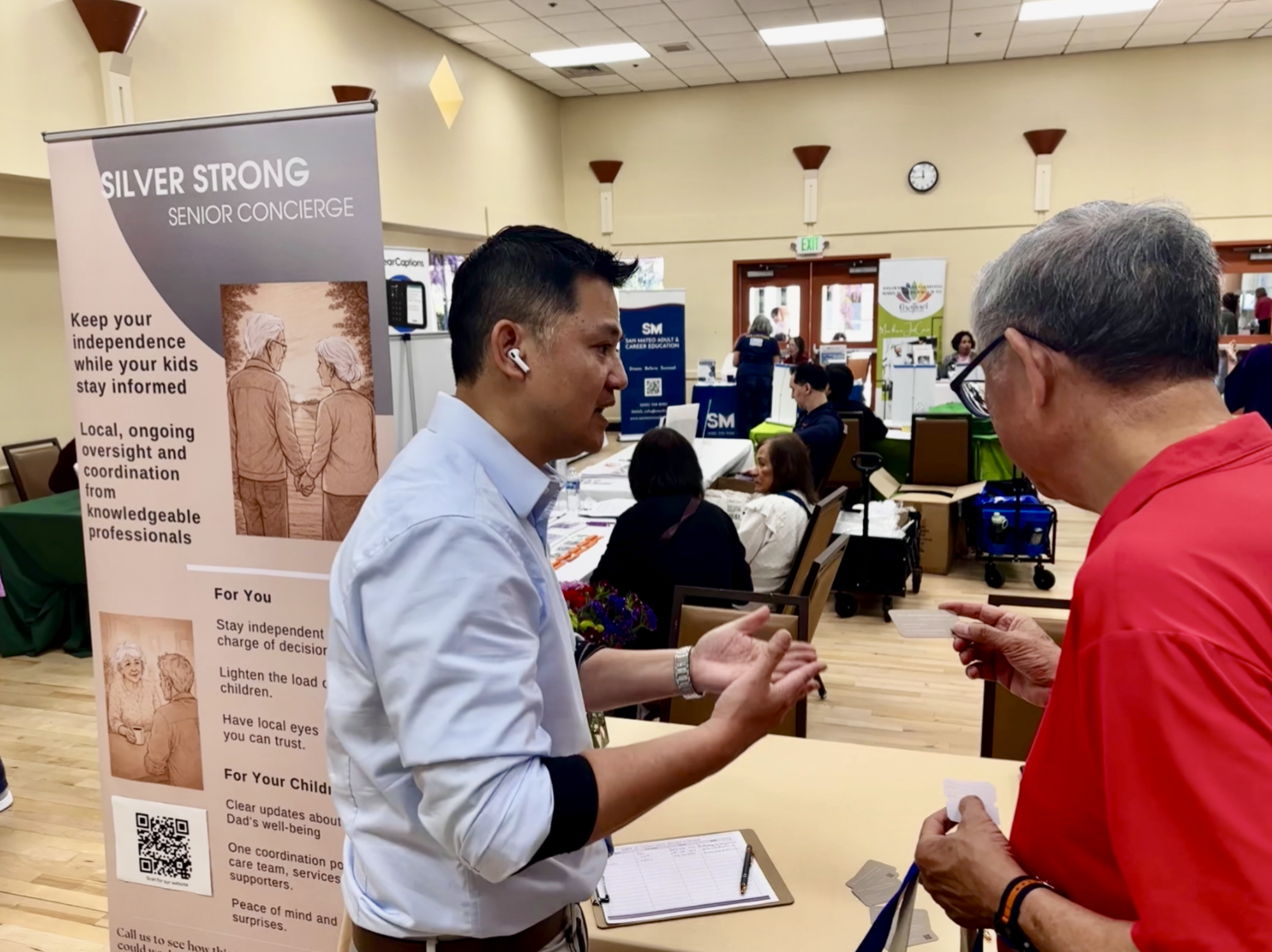
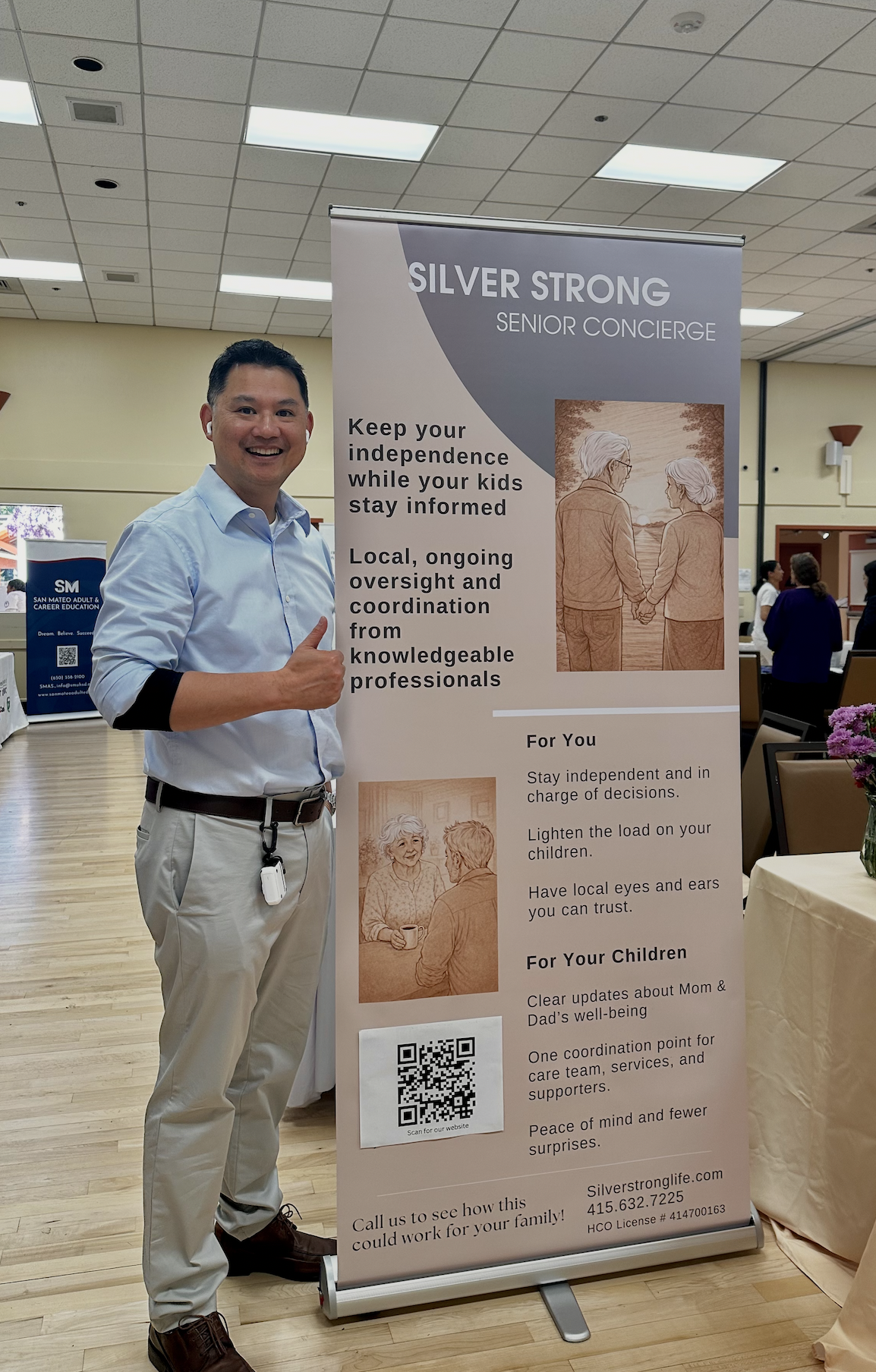
I hosted my first booth at the Belmont Senior Showcase on March 20, 2026, and I can honestly say it was a joy. Watching seniors and their adult children walk from booth to booth — asking questions, collecting resources, and learning about services they never knew existed — was one of the most wholesome experiences I've had since launching Silver Strong Life. The energy in the room wasn't anxious or clinical. It was hopeful. Families were being proactive, and that's exactly when planning works best.
What Happens at a Senior Expo?
The Belmont Senior Showcase, held at Twin Pines Senior & Community Center, featured a resource fair with local professionals, live music, free dental screenings, blood pressure checks, oxygen and glucose level testing, and a raffle — which, if you've ever been to one of these, you know seniors absolutely love.
But the real value? Having dozens of senior-focused professionals in one room, ready to talk to you for free. No appointments, no sales pressure — just conversations that help you understand what's available before you actually need it.
Senior Services You'll Find at Expos Like This
Here's a breakdown of the types of professionals and services represented — and why each one matters if you're helping an aging parent.
In-Home Care
Different types of caregiving options who come to your parent's home to help with everything from companionship and light housekeeping to hands-on personal care — allowing them to age in place on their own terms.
In Silver Strong Life's case, we provide oversight and coordination — think of it as a local eyes and ears who coordinates all of the various services listed here, keeps everything organized and on track, and makes sure adult children stay informed about what's going on with Mom and Dad. Because when you're busy with work, raising your own kids, or living hours away, having someone local who's watching the full picture makes all the difference.
Assisted Living and Independent Living Communities
Communities that offer different levels of support — from seniors who simply want maintenance-free living and social connection, to those who need daily help with meals, medication, or personal care. If you've ever wondered whether it's "time" for Mom or Dad to move, the advisors at these booths can walk you through what each level of care actually looks like.
Insurance and Medicare Guidance
Insurance professionals who can help you and your parents navigate the options that feel the most overwhelming — Medicare, Medi-Cal, supplemental (Medigap) plans, Medicare Advantage, prescription drug coverage (Part D), Private Insurance, Term life and long-term care insurance.
Estate Planning and Trust Attorneys
Legal professionals who help seniors and their families protect assets, establish powers of attorney, and make sure wishes are documented before a crisis forces decisions under pressure. If your parents haven't completed their estate planning documents yet, this is one of the most important conversations you can start.
Senior-Focused Realtors
Real estate professionals who understand what seniors need to rightsize into a home that fits their current lifestyle — whether that means downsizing, moving closer to family, or finding a single-story layout that's safer long-term.
Reverse Mortgage Specialists
Financial options for seniors who want to utilize their home equity to fund their lifestyle without the hassle of a full-blown refinance. These professionals can explain whether this path makes sense for your parent's situation.
Free Public Resources
Senior community centers and county-funded transportation services that provide meals, social activities, health screenings, and rides to medical appointments. These are very often underused simply because families don't know they exist. A quick conversation at an expo can connect your parent to programs that are already paid for by your tax dollars.
Technology for Aging in Place
Devices and services like fall detection systems, captioned phones, medical alert tools and tech support services that give seniors more independence — and give their families some peace of mind. Technology has come a long way, and many of these solutions are simpler and more affordable than you'd expect.
Why Senior Expos Matter for Adult Children
Most families don't start researching senior care until something goes wrong — a fall, a hospitalization, a sudden decline. By then, you're making decisions under stress with limited information.
Senior expos flip that script. They give you the chance to learn what's available, meet the people behind the services, and start building a plan while things are still stable. Even if Mom and Dad are doing fine right now, knowing who to call and what options exist means you won't be starting from zero when the time comes. Otherwise, if you wait and when a major change occurs, the unfortunate truth is that you will have to spearhead all of above all at once!
Don't Wait for a Crisis — Start the Conversation Now
If you're an adult child wondering how to help your Mom and Dad and, whether they're still fully independent or starting to need a little more support Silver Strong Life is here to help you get organized and stay informed.
Our Family Clarity Visit is a simple first step: a one-time, in-home visit where we observe how Mom or Dad is doing day-to-day, identify any gaps or risks, and give you a clear picture of where things stand — so you can plan ahead with confidence instead of reacting to emergencies.
Schedule a Family Clarity Visit →
Serving families in San Mateo County and surrounding areas.
When a Warm Fridge Becomes a Warning Sign for Aging Parents
This story about my friend Larry and his mom, Angie, will feel familiar if you’re trying to keep a parent safe while living in another city. Angie is 75 and lives alone in Los Angeles. Her son, Larry, is a firefighter in San Francisco and a father of three. Between long shifts and family responsibilities, Larry can only visit his mom every few months. On one visit, he noticed something quite concerning.
Angie’s refrigerator didn’t feel very cold. When he checked the temperature, it was 53 degrees. 😮 He asked his mom about it, and she shrugged: “Oh? It feels fine to me.” 🤷🏼♀️
Larry realized she had likely been eating spoiled food without realizing it. He measured the fridge, ordered a replacement online, and arranged for delivery. But the soonest delivery date was after he had to fly back home for work. So Larry did what many devoted adult children of aging parents do. He flew back to Los Angeles about a week later to be there when the delivery team arrived. He cleared a path in the kitchen, spoke with the installers, and made sure everything worked before heading back to San Francisco again.
All of this—for one fridge.
Many adult children in the Bay Area are juggling careers, children, and the growing responsibility of caring for aging parents—often from a distance.
If you see yourself in Larry’s story, you’re not alone. Silver Strong Senior Concierge provides local oversight and coordination for Mom and Dad in San Francisco Bay Area, so small issues don’t turn into long‑term problems when you live far away. If you’re juggling work, kids, and an aging parent and want a trusted partner nearby, you can learn more about how we support your family or book a brief, no‑obligation consultation.
Silver Strong Senior Concierge
Home Care Organization Licensed #414700163
Serving families with aging parents in San Mateo County and San Francisco County
Start helping your Mom and Dad by gather these 7 documents first!
I recently met up with some longtime friends who have experience caring for their parents and we talked about how things started for them. I noticed a common theme.
“It was so awkward talking to my mom about this topic.”
“I want to help, but I don’t even know where anything is.”
“After the work week ends, I’m already spent and really don’t want to think about another thing.”
And you know what? I have felt the exact same way. The interesting part is the gap between parents and their children. Parents value their independence and dignity and don’t want to burden their kids. Adult children want to help, but simply do not know where to start. Then...a fall, a stroke, or a cognitive shift. The parent becomes disabled/incapacitated and the adult children have to hit pause on their own lives and enter a state of prolonged triage. Suddenly they are dealing with the entire system all at once: hospitals, insurance, Medicare, pharmacies, and often banks, attorneys, and government agencies. 🤯
If you want to get ahead, ask your mom and dad if you can help gather few key documents. Take photos of these documents, put them in a secure drive, and share them only with trusted members of the family.
1. 𝐃𝐫𝐢𝐯𝐞𝐫’𝐬 𝐋𝐢𝐜𝐞𝐧𝐬𝐞: Primary form of ID for hospital admission, pharmacy pickup, and signing legal documents.
2. 𝐒𝐨𝐜𝐢𝐚𝐥 𝐒𝐞𝐜𝐮𝐫𝐢𝐭𝐲 𝐂𝐚𝐫𝐝: Needed to apply for benefits, update Medicare, and handle Social Security matters.
3. 𝐌𝐞𝐝𝐢𝐜𝐚𝐫𝐞 𝐂𝐚𝐫𝐝: Hospitals and doctors need this immediately to
verify coverage and process claims.
4. 𝐏𝐫𝐢𝐦𝐚𝐫𝐲 𝐈𝐧𝐬𝐮𝐫𝐚𝐧𝐜𝐞 𝐂𝐚𝐫𝐝: Prevents surprise bills and ensures proper coverage for treatments, procedures, and hospital stays.
5. 𝐌𝐞𝐝𝐢𝐜𝐚𝐥 𝐈𝐧𝐟𝐨𝐫𝐦𝐚𝐭𝐢𝐨𝐧: Blood type, medications, allergies, and
PCP info. Instant context of your parent’s general health.
6. 𝐀𝐝𝐯𝐚𝐧𝐜𝐞 𝐇𝐞𝐚𝐥𝐭𝐡 𝐂𝐚𝐫𝐞 𝐃𝐢𝐫𝐞𝐜𝐭𝐢𝐯𝐞: Tells doctors what medical
treatments your parent does or doesn't want (i.e., feeding tubes, ventilators).
7. 𝐇𝐞𝐚𝐥𝐭𝐡 𝐂𝐚𝐫𝐞 𝐏𝐨𝐰𝐞𝐫 𝐨𝐟 𝐀𝐭𝐭𝐨𝐫𝐧𝐞𝐲: Legally authorizes someone to make medical decisions if your parent is unable to make decisions for themselves.
𝐋𝐢𝐧𝐢𝐧𝐠 𝐮𝐩 𝐭𝐡𝐞𝐬𝐞 𝐝𝐨𝐜𝐮𝐦𝐞𝐧𝐭𝐬 𝐞𝐬𝐭𝐚𝐛𝐥𝐢𝐬𝐡𝐞𝐬 𝐚 𝐬𝐨𝐥𝐢𝐝 𝐟𝐨𝐨𝐭𝐢𝐧𝐠, 𝐚𝐧𝐝 𝐜𝐚𝐧 𝐜𝐚𝐥𝐢𝐛𝐫𝐚𝐭𝐞 𝐲𝐨𝐮𝐫 𝐞𝐧𝐭𝐢𝐫𝐞 𝐮𝐩𝐜𝐨𝐦𝐢𝐧𝐠 𝐣𝐨𝐮𝐫𝐧𝐞𝐲. Family alignment isn’t achieved overnight, but starting with this one practice gives you a great foundation to build on.
If you want to talk about it, feel free to book a consultation with me. 🤝
Announcing Silver Strong… Support for Busy Professionals with Aging Parents in the Bay Area
A new chapter: licensed and launched
I recently received my Home Care Organization (HCO) license from the California Department of Social Services, and I’m excited to officially launch Silver Strong, a service dedicated to helping busy working professionals support their aging parents in the Bay Area.
Many of us are in that “in‑between” place. Our parents are mostly independent, but they’re starting to show mild changes. We notice little slips, small safety concerns, or shifts in judgment and wonder what they mean—and what to do next.
At the same time, life is already full. Adults in their 40s and 50s are often raising children, working full time, and staying involved with their parents’ lives. It’s no surprise that staying on top of every appointment, document, and decision can start to feel overwhelming.
What Silver Strong does
Silver Strong focuses on non‑medical oversight, coordination, and support (non‑personal care) for aging parents who are still living at home.
That can include:
Keeping an eye on changes in day‑to‑day functioning or behavior
Helping organize “senior life” — appointments, professional services, and key logistics
Coordinating communication so the whole family stays informed and aligned
Flagging emerging concerns early, before they turn into emergencies
My role is to be a trusted local point person—someone who can notice patterns, ask good questions, and help families make thoughtful decisions without having to carry everything alone.
Who do I help
Silver Strong works with busy adult children whose parents live in the Bay Area and are:
Generally independent, but showing mild cognitive or functional changes that raise questions or concerns
Living alone or without nearby family and friends who can regularly check in
Many of my friends are in that “sandwich generation,” balancing work, kids, and aging parents, often from a distance. They care deeply about their parents and want them to stay safe, independent, and respected—but they can’t always be there in person.
Silver Strong steps into that gap as the local “eyes and ears,” helping adult children stay connected and informed, even when they’re not physically nearby.
Let’s connect
If this sounds like the stage your family is in—or you’re starting to sense that something is shifting with your mom or dad—I’d be honored to talk about what support could look like for you.
You can learn more or reach out makeitcount@silverstronglife.com or 415.632.7225
HCO Lic #414700163